This is the story of the most famous Bronco, that really isn't a Bronco......
We will start this story telling you about the name: Big Oly.
Ole is a name in Scandanavia, but that has nothing to do with this Big Oly.
In this case Oly is short for Olympia, as in Olympia Beer the sponsor of the ultimate race Bronco err vehicle.

For those that do not know, Olympia beer was brewed in Olympia, Washington. The brewery, which still stands along Interstate-5 in Tumwater (Tumwater sits right next to Olympia). The Olympia brewery was built there because of an Artesian well which provided good, clean water for brewing beer, thus the tag line "It's the Water".
Race fans, especially off-road race fans drank beer, and it made perfect sense to the owners of Olympia Brewery to sponsor the Parnelli Jones Bronco.
Now let's talk about the men who built this rig.
We'll start with the man whose name became synonymous with Classic Broncos: Bill Stroppe.
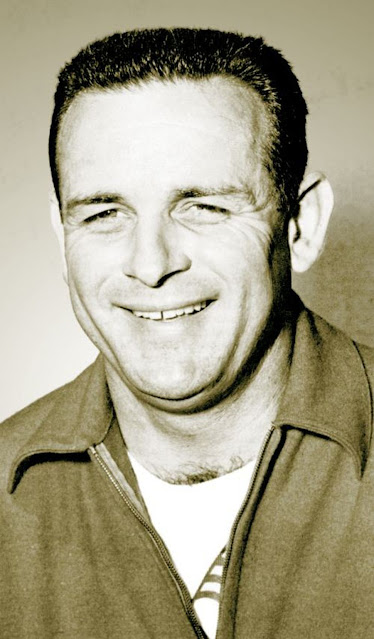
William Stroppe was born in 1919 in Long Beach, California.
He began racing in the late 1940's while working at a service station in California.
Dry Lakes Racing was just getting started and Bill had befriended a man named Clay Smith. Smith built racing engines and was known for his custom ground camshafts.
In 1947, after witnessing some of Stroppe's wins (and the teams engineering feats), Ford agreed to sponsor his racing efforts, Hot Rods and racing were becoming very popular (Hot Rod Magazine debuted the following year).
Before long Stroppe was racing in every sort of competition there was: Boat racing, Pikes Peak, SCCA, NASCAR, Le Mans and even the Mobilgas Economy Runs.
In 1950 an endurance race across the deserts of Mexico was held, called the "Carrera Panamericana". The race was believed to be the most dangerous of its kind. That kind of publicity drew adventurous men from all over. Stroppe could not resist the opportunity and prepped several cars for the race.
Stroppe's team of Lincolns dominated the field and took home the top 4 spots in both the 1952 and 1953 Panamericana races.
After 4 years, the Panamericana was cancelled (in 1955), which led to a series of unsanctioned speed runs along the Baja California peninsula. In 1962 a timed run was performed to establish the course and limits of a race. Five years later the first Baja/Mexican 1000 race was held, running from Tiajuana to La Paz.
By this time Stroppe had formed a team with Holman & Moody to build race cars and off-road racing trucks.
Stroppe's association with John Holman went back years as he had once employed John Holman as part of his race team, Holman was now part of a NASCAR racing team based in North Carolina.

Parnelli Jones next to one of the first Broncos to ever be modified

Ford, who at the time embraced the "race on Sunday-sell on Monday" approach, asked Stroppe about preparing factory Broncos with some of the off-road proven parts and sell them at Ford Dealerships, similar to the Shelby Mustangs....this was the birth of the Baja Bronco, but that is another story.
While Stroppe and his team built the Big Oly, it was Parnelli Jones who dreamed it up and financed it.

Rufus Parnell Jones was born in 1933 and grew up in Southern California, aka Hot Rod Central.
Nicknamed Parnelli by his boyhood friend, he began racing at the age of 17 and found he had a knack for it.
Parnelli was the first to qualify for the Indianapolis 500 at over 150mph in 1962 and won the race in 1963. He has raced every type of car and on every type of track. Truly a pioneer in automotive racing.
It was Jones' success in driving and Stroppe's success in car building that led them to each other.
Stroppe had built several race cars for Jones, I believe the picture below is from Pikes Peak, does the paint scheme look familiar?

In the late 60's Bill Stroppe wanted Jones to get into desert racing and after enough prodding Jones agreed.
Stroppe & Jones entered the 1968 StarDust 7-11 in a Stroppe prepared Bronco, but Jones did not finish due to mechanical problems....something Stroppe would come to learn about Parnelli....he wasn't easy on equipment. If a rig could survive Parnelli's punishment, it could survive anything.
In November of that year the two entered the Baja 1000, but only made it to the 150-mile mark, again it was a mechanical failure.
These failures were usually in the weak Dana 30 front axle, there is a story about Ford shipping pallets of new front axles to Stroppe to keep the Broncos running.
It is entirely possible that Stroppe is at least partially responsible for the Bronco getting the Dana 44 front axle as factory equipment.
It was also during this time that Stroppe's shop was building Broncos for other race teams, including Larry Minor and Rod Hall who won the Baja 1000 in 1968 and 1969 in a Stroppe prepared Bronco.
Note the "Cactus Smasher" push bar and bumper braces (bolt heads on the outer edges of the bumper)....two items that made their way to the Baja Bronco.

While at Stroppe's shop Jones spied a chassis that was gathering dust. It wasn't just any chassis; it was a one of a kind 2-wheel drive concept Bronco that featured the F-100's twin I-Beam independent front suspension. The chassis was rumored to have been built by Kar Kraft and was an experiment to see if customers would be willing to buy a "kit Bronco" for self-assembly.
The project was scrapped and what was left was offered to Stroppe.


Parnelli tried to convince Stroppe to turn the 2WD concept into a 2WD race vehicle (bypassing the front axle breakage issue), but Stroppe resisted saying that it wouldn't be a real Bronco.
Parnelli then went to Stroppe's best fabricator, Dick Russell, and asked him to build a race rig based on that concept vehicle....at his home, away from Stroppe's eyes.
When Stroppe found out, the project was moved to the Holman-Moody-Stroppe shop in Long Beach.
Parnelli's conviction to the concept led Stroppe to go ahead and to turn the 2wd concept chassis into a race vehicle, while the custom 2WD Bronco was also being built.
The 2WD "Buggy" chassis had a factory installed 289 small block Ford V-8, about 12 inches rear of its normal location. This was part of the dune buggy concept, keep the weight off the front end.
The team installed power steering, a custom roll cage and a fiberglass body that was sectioned 3" to keep a low profile.
This Bronco was named "Pony" and was raced in the 1970 Mint 400 and took home 1st place for Rod Hall and Chuck Looper. Then Stroppe and Jones set a record in the 1970 Baja 500 taking the overall win in just under 12 hours.

Back in Long Beach work began in earnest on the new Parnelli Bronco.
They built a custom chrome-moly tube frame and designed a custom front suspension by shortening Ford 2WD Truck Twin I-Beams by 3" (6" total) and hanging them from custom mounts. This is because the F-100 track width is 7.5" wider than that of a stock Bronco.
The articulation was provided, not by radius arms as a stock Bronco or 2WD truck used, but trailing arms that were mounted in front of the I-Beams. They believed (and rightly so) that this would provide a smoother ride.
Note the PJ in the grill....this was Parnelli Jones' project.


The rear-end was a built up 9" with 4.11 gears, a Detroit Locker and full floating axles. A custom 4-link suspension was designed to absorb the bumps. Total wheel travel was 8-10" while the front had a bit more at 10-12". Suspension seats added a few inches of bounce to assist the driver and passenger.

Hearst/Airheart Disc Brakes were mounted at all four corners.

Tires and wheels originally consisted of 9.00 Firestones up front and 9.50s in the back wrapped around mag wheels, I haven't read if these were aluminum alloy or the original magnesium nor do I know who produced them. I know Parnelli was involved in U.S. Mags, but I don't know if this was before or after Big Oly was being built.
Later the tires were replaced with the Firestone signature Parnelli 1000 tires in 10.50-15 size
For the motor they chose the 351 Windsor block that was heavily modified to produce somewhere in the neighborhood of 400 H.P.. The motor was installed low in the frame and set back considerably to keep the nose from being too heavy, a problem Broncos have always had.
For those that don't know, the 351 Windsor is similar to the 289/302, except it has a 3.5" stroke, compare to that of the 289 & 302 which have 2.87" & 3" strokes respectively (all three share the same 4" bore). This means the deck height is taller and the intake manifold is wider, it also means more torque and horsepower.

Originally a C-4 was installed, but that was replaced by a small block C-6 prepped by B&M out of Van Nuys CA.
The motor was originally powered by propane, propane seemed to solve some problems with carburetors flooding or getting damaged from the incessant bouncing, but filling a propane take in the middle of a desert is not an easy task.
Later a race fuel cell was added, and high-test gasoline through the Holley 650 double pumper provided the motivation.
The body was probably from the same molds as the one made for Pony. Built by a So-Cal Ford Dealer who was also building race Broncos.
Custom round taillights were added to the bob-tailed rear section, this was done because the factory taillights would not fit in due to the body being sectioned by 3".
Up front a chromed factory grill was modified for fog lights (where the factory blinkers once were) and the aforementioned PJ initials.
A wing was added to the top and serves three purposes, one is to aid in creating down force on the rear end, the second is to prevent the rig from sinking in the sand in the event of a roll over and lastly to provide some shade from the unforgiving Mexican Sol.
Here is a picture of one the few parts that did come from a Bronco, the steering wheel. Stroppe had it dipped in foam for comfort and to save on fingers when a bump would pull the wheel from their hands.
These steering wheels became a standard item on the Baja Broncos.

When finished the Bronco was nicknamed Crazy Colt and was painted in a red, white & blue paint job with "Johnny Lightning" graphics and a Stroppe signature flat black hood (to eliminate glare), another item that made its way to the Baja Bronco models. Also note the Petrolane sponsor, they were running on propane at this time.

Within a short time, Olympia offered $5,000 to sponsor the Bronco. Parnelli accepted and it wore their colors throughout its racing tenure from 1970 to 1974.
Parnelli, Stroppe and Big Oly won the Baja 1000 in 1971 & 1972, then the Baja 500 and Mint 400 in '73.


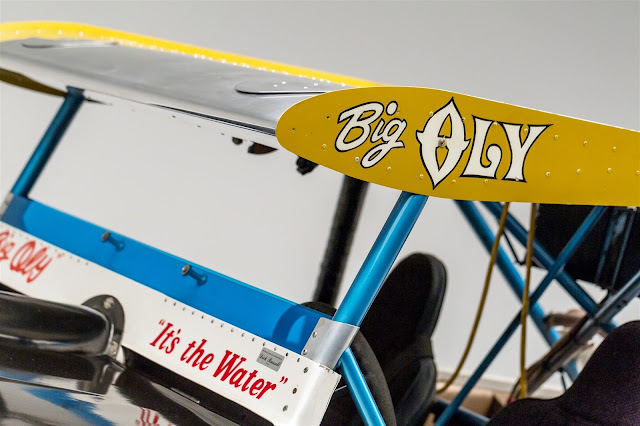
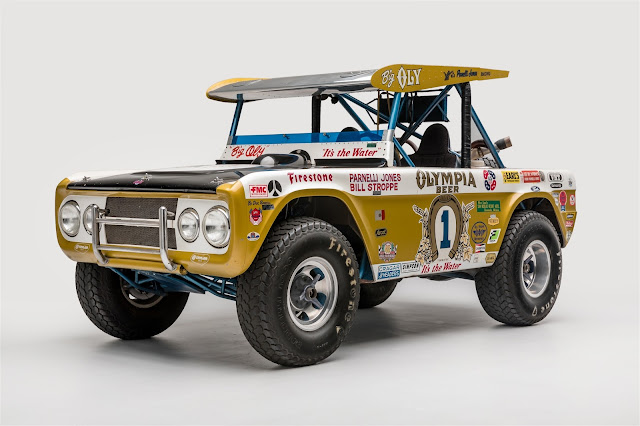
The Big Oly was retired in 1974/75 and remained in Parnelli Jones' possession. Jones' showed the rig at museums and car shows. Then in 2021 he decided to sell Big Oly.
At the Mecum auction in May, held in Indianapolis, a California collector purchased the Big Oly for a record $1.87 Million. The truck will stay in the U.S. and probably continue to be shown.

In 2021 the new owner decided to race Big Oly in the NORRA/Mexican 1000, the driver(s) crashed twice. It was not the first time Big Oly flipped, and may not be the last


Sources:
"Big Oly" Is For Sale: The Most Important Racing Bronco In History (silodrome.com)
Bill Stroppe | Hemmings Motor News
Stroppe Race Bronco: The Birth of "Big Oly" (bajabronco.com)
Big Oly - The Off-Road Racing Ford Bronco That Changed Everything (silodrome.com)
Parnelli Jones' Baja 1000 Winning Ford Bronco "Big Oly" Headed To Auction (hotcars.com)
The Big Oly: The World’s Most Famous Ford Bronco – Mecum Magazine
ORMHOF - Legends Live at the Hall of Fame - Parnelli Jones
Stroppe Race Bronco: Pony's Rise and Fall (bajabronco.com)
$1.8 Million "Big Oly" Bronco Crashed Twice in Baja Race (fordmuscle.com)


